
Industry
Healthcare
Introduction
We still remember the moment we asked ourselves a simple but consequential question: Why can’t we do this here?Chimeric antigen receptor (CAR) T-cell therapy has transformed outcomes for patients with relapsed or refractory hematologic malignancies. Yet, for many patients, access has historically required travel to large academic centers, often hours away, introducing logistical, financial and personal barriers that can delay or even prevent care.That question—why not here?—became our thesis: advanced therapies like CAR T should not be defined by geography.
Over the past 10 years, chimeric antigen receptor T cell (CAR T cell) therapies have transformed the treatment landscape for patients with relapsed or refractory hematologic malignancies. Although these therapies have produced deep and durable responses in subsets of patients with B-cell lymphomas and multiple myelomas, they can be highly toxic and, until recently, were available only at large academic or freestanding cancer centers where toxicities could be safely managed in the inpatient setting. However, not all patients can travel to academic centers to access these potentially curative therapies, as they often face significant logistical, financial, and personal barriers.
More recently, community oncology practices with strong collaborations with local hospitals have been able to safely administer these therapies closer to patients’ homes. At New York Oncology and Hematology in Albany, NY, we have established an infrastructure to safely provide these groundbreaking treatments within the local community, with the goal of reducing obstacles and ensuring greater access to this potentially lifesaving therapy.
Here, we discuss our program, which focuses on providing outpatient CAR T cell therapy in a community oncology setting, with hospitalization reserved for toxicity management. Our experience may provide insight for other community oncology programs developing CAR T cell therapy programs.
Clinical Challenges for establishing an outpatient CAR T cell therapy program
Building a community CAR T cell program that delivers these products safely and effectively requires several steps. Four requirements of a CAR T program include: pharmaceutical company approval and certification of the practice to administer the drug, outpatient collection and administration, inpatient toxicity management, and outpatient short- and long-term follow-up. Pharmaceutical companies require a comprehensive set of standard operating procedures and workflows before a site can be certified. Clinical programs need to demonstrate appropriate infrastructure to support the CAR T patient journey, which includes several steps, such as leukapheresis, lymphodepleting chemotherapy, product reinfusion, and monitoring for toxicities for 14-30 days (Figure 1). The toxicity profile of this novel therapy may require admission to a local hospital for closer monitoring if an adverse event develops. Patient safety is the cornerstone of developing these operating procedures.
Outpatient Infrastructure Requirements
When we started building our program, we mapped the patient journey, from consultation through CAR T-cell infusion after lymphodepleting therapy to short- and long-term follow-up to monitor for toxicities, as detailed in Figure 1. While it is important to think of this process in broad terms, patient safety depends on the details of both the outpatient and inpatient infrastructures that support the service line.
The first challenge for community oncology practices is determining how to apherese these patients to generate the CAR T cells. We were fortunate to already have a contract with New York Blood Center through our autologous stem cell transplant program. However, other practices we had communicated with early in the process needed to explore the Red Cross and blood centers in their area. We also had to evaluate products that could be delivered via a liquid nitrogen dewar (i.e., a “Just-in-Time” delivery), as we could not administer any product that required special freezers or a cellular therapy laboratory, because these items are not available in our practice. In addition, we needed to ensure that we had other items in place, including water baths and staff training for the preparation and infusion of these products. Establishing these initial steps enabled us to safely administer CAR T cells to patients in the outpatient setting.
The next layer of infrastructure, which included outpatient monitoring and management of CAR T toxicities, was far more complex. It raised several issues, including the frequency of daytime toxicity monitoring visits, staffing for clinical and quality reporting, overnight coverage and check-ins, inpatient admissions for toxicity, staff education, and subspecialty provider engagement, including services in neurology, critical care, infectious disease, and pulmonology. We are fortunate to have trained stem cell nurses and to have achieved FACT accreditation for autologous stem cell transplant, which enabled us to pivot easily into CAR T cell therapy clinical care, CIBMTR reporting, and quality measure assessments. These elements may need to be built from the ground up for a different community program without prior stem cell therapy experience. We also had weekend coverage in place, based on our autologous stem cell program. We discovered early on that when night coverage was entirely driven by two physicians, there was a high risk of rapid burnout after treating only three patients with CAR T cell therapy. To address this issue, we established a nursing-driven system with overnight phone assessments, and we are exploring incorporating APP colleagues into overnight calls for clinical assessments following CAR T infusion as our program expands.
Long-term outpatient follow-up has become the easiest component to develop. However, we recommend defining when a patient will return to the referring provider and which educational materials and information should be provided at handoff to appropriately manage long-term toxicities, including pancytopenia, infection risk, disease relapse, and hypogammaglobulinemia. In addition, a number of other issues have emerged in the long-term follow-up setting, which we have been addressing as we have treated more patients with CAR T cell therapy and which will also need to be considered by other practices developing a CAR T cell program. These issues include whether to revaccinate with a broad set of vaccines or to check antibody titers once cell counts have recovered post-lymphodepletion therapy to determine the need for specific vaccines on an individual basis. In addition, it will be important to determine the appropriate time to discontinue antibiotic prophylaxis once counts recover. While some of these topics may be controversial, with limited data to support specific guidelines, developing programs will need to define a care plan that incorporates these items to optimize quality management and maintain a consistent approach for patients receiving CAR T therapy.
Inpatient Infrastructure Requirements
On the inpatient side, we quickly realized that engaging our local academic hospital, which was also eager to bring these novel treatments to our region, was essential. Our local hospital administration and clinical colleagues were instrumental in creating an environment within their institution that prioritized this, leading to a robust inpatient infrastructure for patients admitted with CAR T toxicities. As a result, we implemented multiple identifiers in a cellular therapy patient’s chart and, if admitted for toxicities, inpatient room signage to alert the inpatient care team to possible adverse events that may occur following CAR T infusion. Email correspondence with the hospital admissions department ensured that a bed was reserved for each patient receiving CAR T therapy and that it remained available for at least 7 days post-infusion, potentially up to 14 days depending on how well the patient tolerated therapy.
To ensure consistent inpatient clinical care and excellence, we also train 250-300 clinical staff members annually on CAR T and related toxicities, including CRS and ICANS. The staff includes residents, emergency room staff, nurses, and care providers from multiple subspecialties. We schedule the training for July and August each year to capture new residents and clinical fellows starting at the local hospital. The team at our hospital has also worked with us to create new workflows for contacting CAR T team members at night and for directly admitting patients at any time of day to bypass the emergency room.
The established inpatient infrastructure was a collaborative partnership focused on patient safety, with an utmost emphasis on the quality of toxicity management. However, we anticipate that community practices in a competitive environment with nearby academic centers may face challenges in establishing these types of collaborative efforts. It will be important to evaluate the relationship each practice has with a partner hospital to determine the optimal steps for creating an inpatient infrastructure that enables community practices to safely administer outpatient CAR T therapies and admit patients for CAR T cell-related toxicities.
We also recommend that community oncology programs interested in developing a CAR T program evaluate the FACT community provisional accreditation checklist alongside the pharmaceutical readiness plans to determine the best approaches for establishing outpatient and inpatient infrastructure for the safe and effective delivery of this therapy. Incorporating this into the early phases of planning will be essential for success. While the decision to pursue FACT accreditation will be made by each community oncology program, the checklist referenced above can serve as a guide for establishing a program focused on quality and safety. Following these steps will facilitate the development of the standard operating procedures required for pharmaceutical approval to administer each product. Once a program has been developed, we recommend starting at a low volume and ramping up the number of CAR T patients based on the program’s capabilities.
The ultimate goal is to enable the safe delivery of CAR T therapies to patients closer to home. With this in mind, our program has also found it useful to run a mock patient for each new product introduced to the practice and to meet quarterly with representatives of our subspecialty departments to assess quality improvement. Our program also meets biweekly to review patients who have received CAR T therapy, with an emphasis on toxicity management; discuss patients potentially eligible for CAR T cell therapy; review potential cell therapy clinical trials; and learn about cutting-edge therapies through CME presentations by members of our CAR T working group outlining the latest technology that we may be able to incorporate into our program.
The CAR T Patient Journey
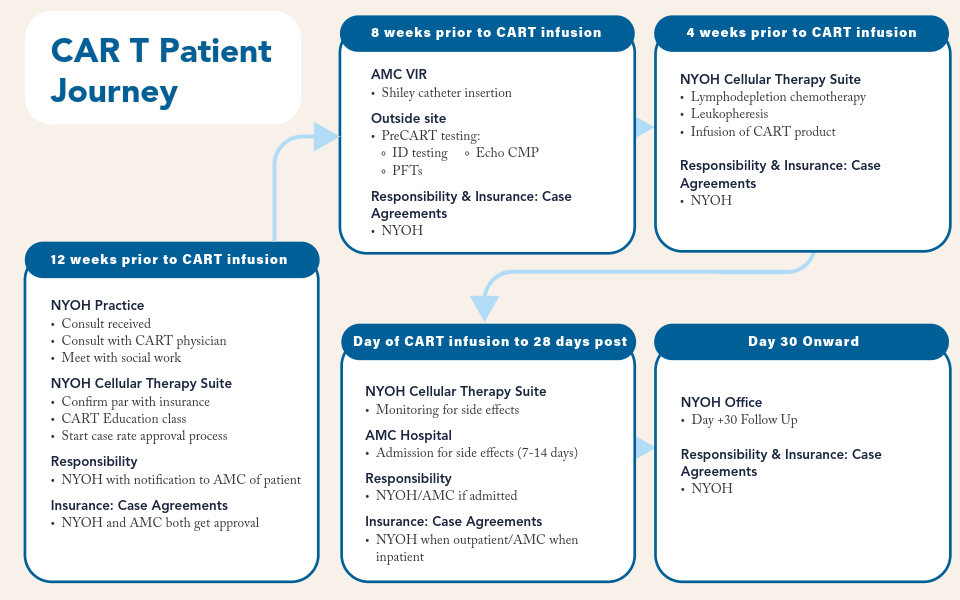 Figure 1. CAR T Patient Journey from consult through first 30 days following CAR T infusion. Summary of the steps warranted to successfully administer CAR T cell therapy, with hospitalization reserved for management of potential side effects. Abbreviations: NYOH (New York Oncology Hematology), AMC VIR (Albany Medical Center vascular interventional radiology), AMC Hospital (Albany Medical Center Hospital).
Choosing the Right Patients and Product Upfront
One of the most critical determinants of success in cellular therapy is the appropriate selection of patients and products at the outset. This requires not only clinical judgment but also a deep understanding of product-specific characteristics, patient comorbidities, disease biology, and logistical considerations for both administration and monitoring cell therapy toxicities in the outpatient setting.
Our experience with lisocabtagene maraleucel (Breyanzi, referred to as liso-cel moving forward), gained through our center’s participation in the OUTREACH study, reinforced the importance of selecting therapies that align with the capabilities of a community-based program. The OUTREACH trial demonstrated that liso-cel can be safely administered in outpatient and community settings, with low rates of severe cytokine release syndrome (CRS) and neurologic events (ICANS), supporting its feasibility beyond academic centers (Linhares et al., 2024). This finding enabled safer outpatient management pathways and expanded access for patients who may not be candidates for treatment far from home.
Similarly, idecabtagene vicleucel (Abecma, referred to as ide-cel moving forward) has delivered meaningful outcomes for patients with relapsed or refractory multiple myeloma. However, its use requires careful patient selection, particularly for those with higher disease burden or comorbidities that may increase the risk of toxicity. Balancing efficacy with safety remains paramount, especially in the community setting, where resource allocation and clear pathways for managing toxicities, including CRS and ICANS, must be defined.
We elected to start with both products for our first patients with refractory B-cell malignancies, based on their relatively low toxicity profiles compared with other commercial products and our experience administering liso-cel in the outpatient setting. Our first patient received ide-cel on April 1, 2025, and his side effects were monitored and managed in the outpatient setting. To date, we have treated 6 patients with either liso-cel or ide-cel, with the majority managed entirely in the outpatient setting and one thus far admitted for CRS toxicity.
Ultimately, thoughtful upfront decision-making and matching the right patient to the right product improve outcomes, minimize complications, and support the sustainability of a community-based cellular therapy program.
Fiscal Responsibilities to Establish a CAR T Program
Given that the cost of CAR T cell therapies can exceed $500,000 and the infrastructure described above also costs several thousand dollars, it is essential to secure payor coverage for this therapy upfront to maintain a viable outpatient CAR T cell program without bankrupting a community oncology practice. Furthermore, the hospital partner will require appropriate reimbursement for hospitalization for toxicities, including CRS and ICANS. Fortunately, for inpatient admissions related to CAR T cell therapy toxicities, the hospital can submit Diagnostic-Related Groups (DRGs) to receive reimbursement. That said, it will be prudent and fiscally responsible to ensure that a patient’s insurance aligns with the partner hospital PRIOR to the administration of CAR T cell therapies, in anticipation of potential inpatient admission for toxicities. This will ensure that the partner hospital maintains reimbursement for services and supports its collaborative working relationship with the community oncology practice.
Securing reimbursement for a private community oncology practice offering CAR T cell therapies in the outpatient setting requires additional effort. We are fortunate to have a robust financial and contracting department within our practice that can work directly with payors to secure contractual agreements covering CAR T therapies and the infrastructure required to safely deliver them in the outpatient setting. Confirming insurance authorization with payors that agree to cover these therapies can take several weeks, so it is essential to determine whether this authorization timeframe and a contract to ensure reimbursement will meet each individual patient's needs. Part of the authorization process may require review of unique payor requirements for cell therapy coverage, including patient enrollment in prespecified programs identified by the insurance plan to cover costs and minimize out-of-pocket expenses. Fortunately, many patients are eligible to receive bridging therapies prior to CAR T cell therapy, which can provide time for the authorization process and for the generation of these cell therapies, which can also take up to three weeks.
After months of discussions and negotiations with private insurance companies during our initial program startup, we have established a group of payors with whom we can consistently contract to provide this therapy and receive appropriate compensation to cover drugs and the infrastructure costs cited above. We continue to negotiate with other local payors, with the future goal of offering this therapy to Medicare patients with secondary insurance plans, pending fair compensation for the drug and supportive care. While a single-case agreement model was initially considered, it was challenging during the early phases of our program to determine a fair cost for supportive care beyond the drug cost agreed upon between our practice and each individual payor. Therefore, our payment model involves requesting the drug cost plus a percentage above the drug cost to cover the infrastructure described above, with other services, including lab work and supportive therapies, as standard-of-care services to be “pass-through” items charged directly to the payor. As we gain more experience and a clearer sense of the cost of supportive care for managing our CAR T patients, we hope to negotiate single-case agreements as the program matures.
Future Directions: Building a Sustainable and Expanding Program
As the field continues to advance, our approach to expanding our cell therapy program must keep pace. At New York Oncology and Hematology, we are actively developing our cellular therapy services with a focus on safety, access, and innovation.
A key area of growth is the incorporation of newer agents as they become available. With an expanding pipeline of CAR T-cell therapies and other immune effector cell (IEC) treatments, community practices must remain agile and prepared to adopt emerging therapies that offer improved efficacy and safety profiles.
In parallel, we are exploring strategies to mitigate treatment-related toxicities and reduce the likelihood of hospitalization for each patient. For example, the use of prophylactic steroids is an evolving approach that may help reduce the incidence and severity of CRS and neurotoxicity without compromising therapeutic efficacy. Implementing these strategies can further support outpatient models of care and improve the patient experience. We are also actively incorporating remote monitoring devices to identify and treat signs of toxicity earlier.
Program expansion also requires investment in clinical providers and support staff to further strengthen our infrastructure and safely deliver these therapies to higher patient volumes. Broadening provider involvement, including increased physician engagement and the development of advanced practice provider (APP) coverage as discussed above, will be essential to ensure continuity of care, timely patient monitoring, and program expansion. Our program is fortunate to advance subspecialization among providers in the hematologic malignancy space, honing expertise in treating complex hematologic malignancies in the community setting. Dedicated APP support can enhance patient education, streamline workflows, and improve overall outcomes. Our future goals include investing in, advancing, and engaging in our subspecialized APP program to support and develop our cell therapy service line.
Importantly, the future of cellular therapy in community settings extends beyond oncology. Emerging data suggest that CAR T-cell therapies may play a role in treating refractory autoimmune and rheumatologic diseases, including systemic lupus erythematosus, systemic sclerosis, and multiple sclerosis. As these indications continue to evolve, the ability to safely deliver these therapies in community-based settings will be invaluable. Expanding access beyond academic centers will not only improve patient access but also broaden the reach of these potentially transformative treatments to a wider population.
Finally, pursuing Immune Effector Cell (IEC) accreditation marks an important milestone in our program's maturation. Our Autologous Stem Cell Transplant program has achieved FACT accreditation, underscoring our expertise in stem cell therapy. We are also preparing for IEC accreditation later this year. Accreditation in cell therapy not only validates the quality and safety of care but also positions community practices as credible, capable partners in delivering cutting-edge therapies and provides payors with recognized expertise for covering the costs of these treatments.
Conclusion
The integration of cellular therapies into community oncology practices marks a significant step toward expanding access to cutting-edge, life-saving treatments closer to home. By prioritizing thoughtful patient and product selection, committing to continuous program development, and maintaining a strong partnership with local hospitals for admission and toxicity management, practices like ours at New York Oncology and Hematology are helping redefine where and how advanced cancer care can be delivered in the community setting.
As we look to the future, collaboration, innovation, and a patient-centered approach will remain central to our efforts, ensuring that the promise of cellular therapy and other novel therapies, including outpatient bispecific therapies, reaches every eligible patient who could benefit from these potentially lifesaving treatments.